Shortlist · Charging & power · 6 models
Compact USB-C chargers that replace the box of plugs: six sizes from 30 W to 140 W, with the port splits that matter
The drawer of chargers exists because every device came with its own. One USB-C charger of the right wattage replaces all of them — but 'the right wattage' depends on what you plug in at the same time, and only some makers publish how the power is shared. Six UK-plug GaN chargers from 30 W to 140 W, compared on the figures their makers actually state.
Quick answer
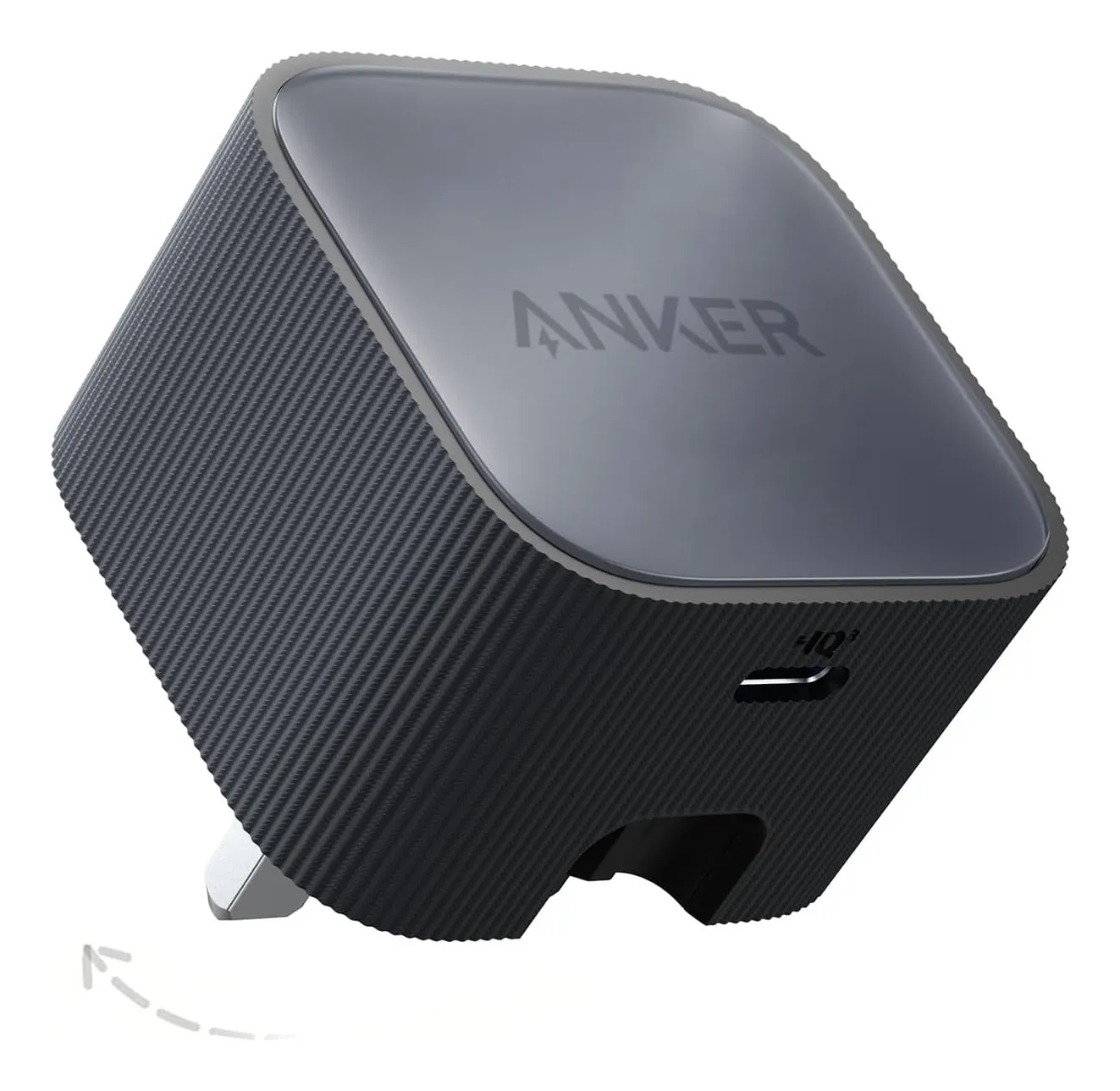
- 30WA phone and nothing elseAnker Nano 30W — one USB-C port, PPS, 72.6 g, folding pins.
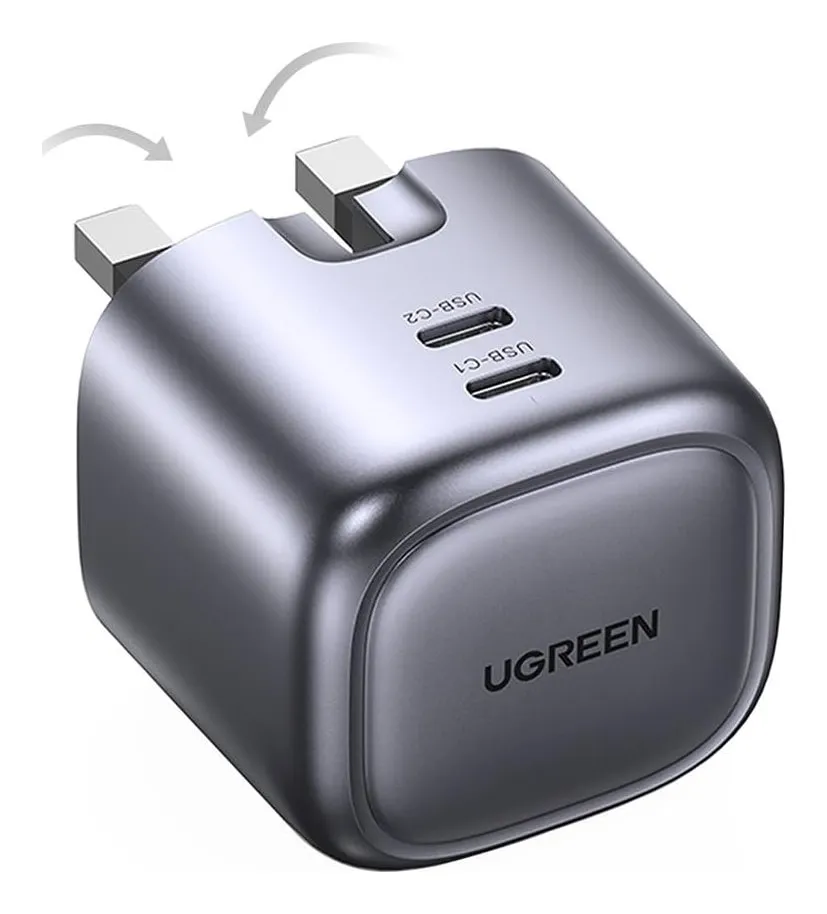
- 45WA Samsung and a second deviceUGREEN Nexode 45W — two USB-C ports, PPS, folding pins; the split is not published.
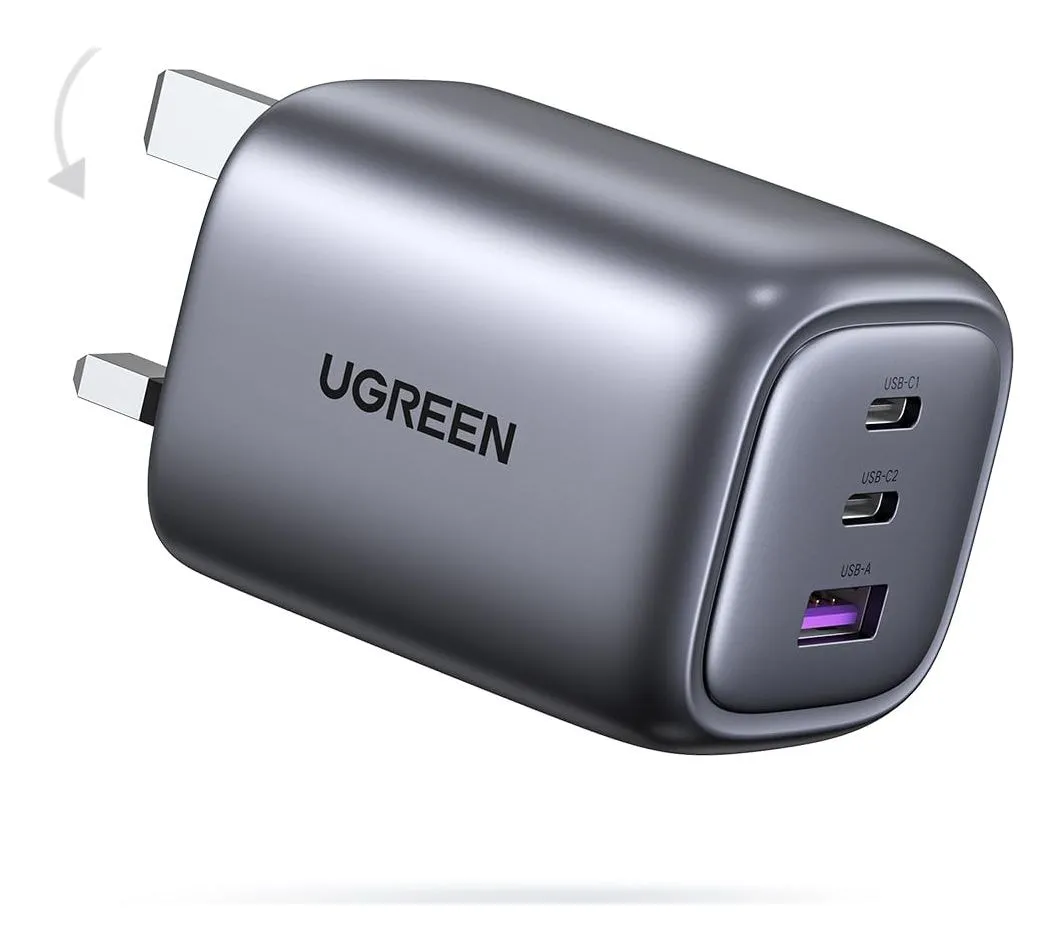
- 65WA laptop, a phone and an old USB-A cableUGREEN Nexode 65W — two USB-C and one USB-A, 57 × 50 × 46 mm, folding pins.
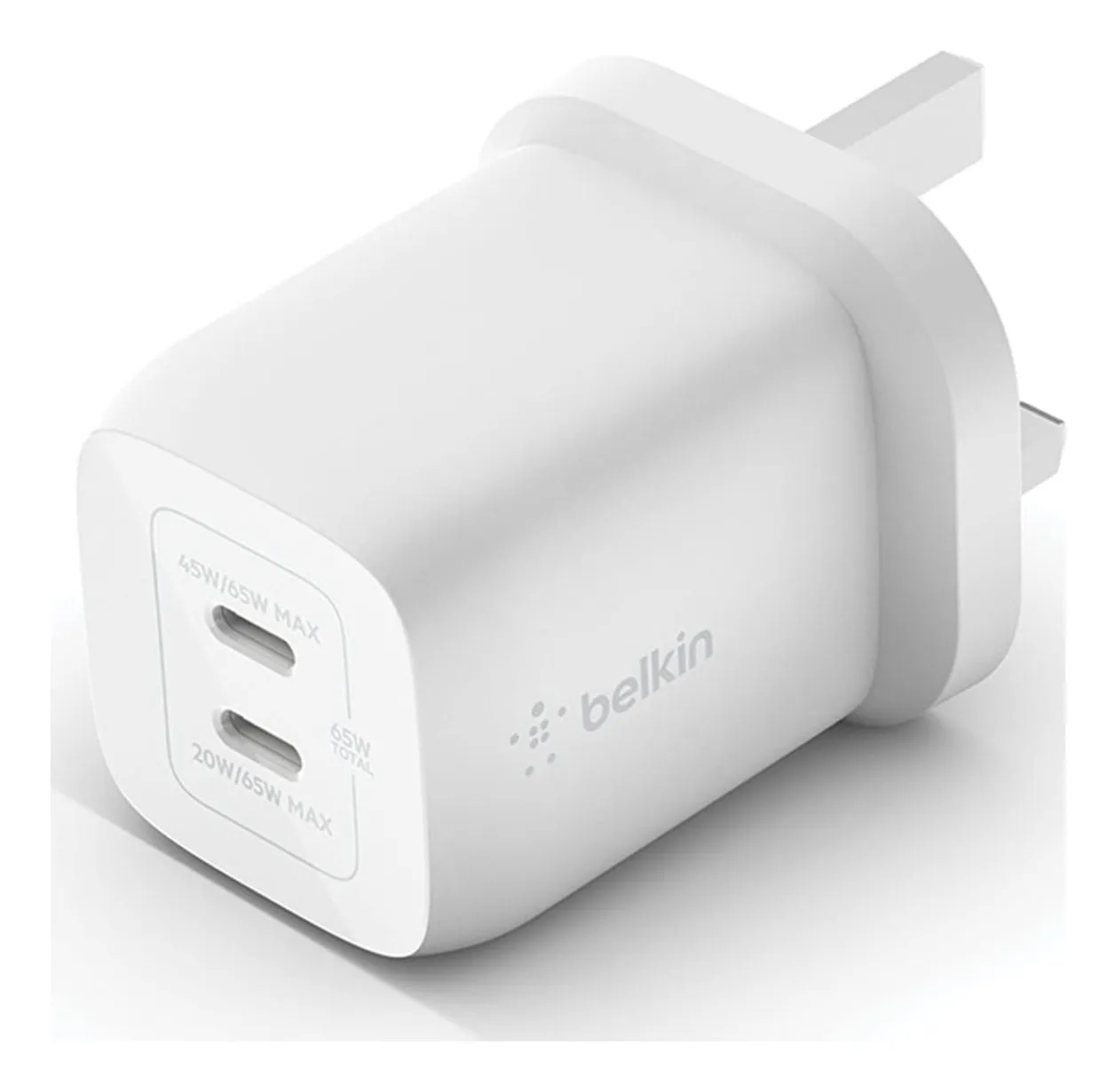
- 65WTwo USB-C devices with a stated splitBelkin BoostCharge Pro 65W — 45 W + 20 W together, PPS on both.
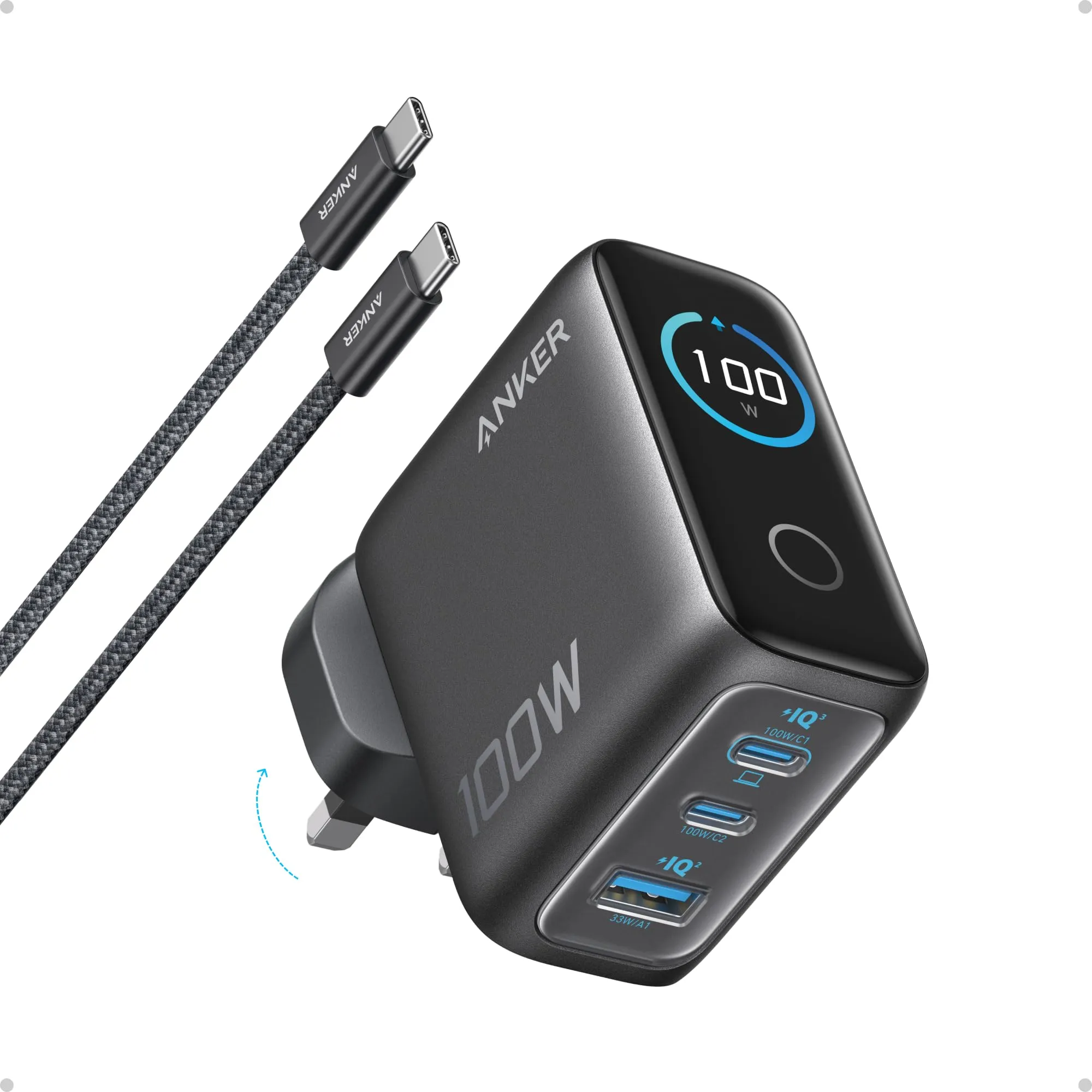
- 100WA laptop that wants the full 100 WAnker 100W 3-port — 70 + 30 W for laptop and phone, touch display, cable included.
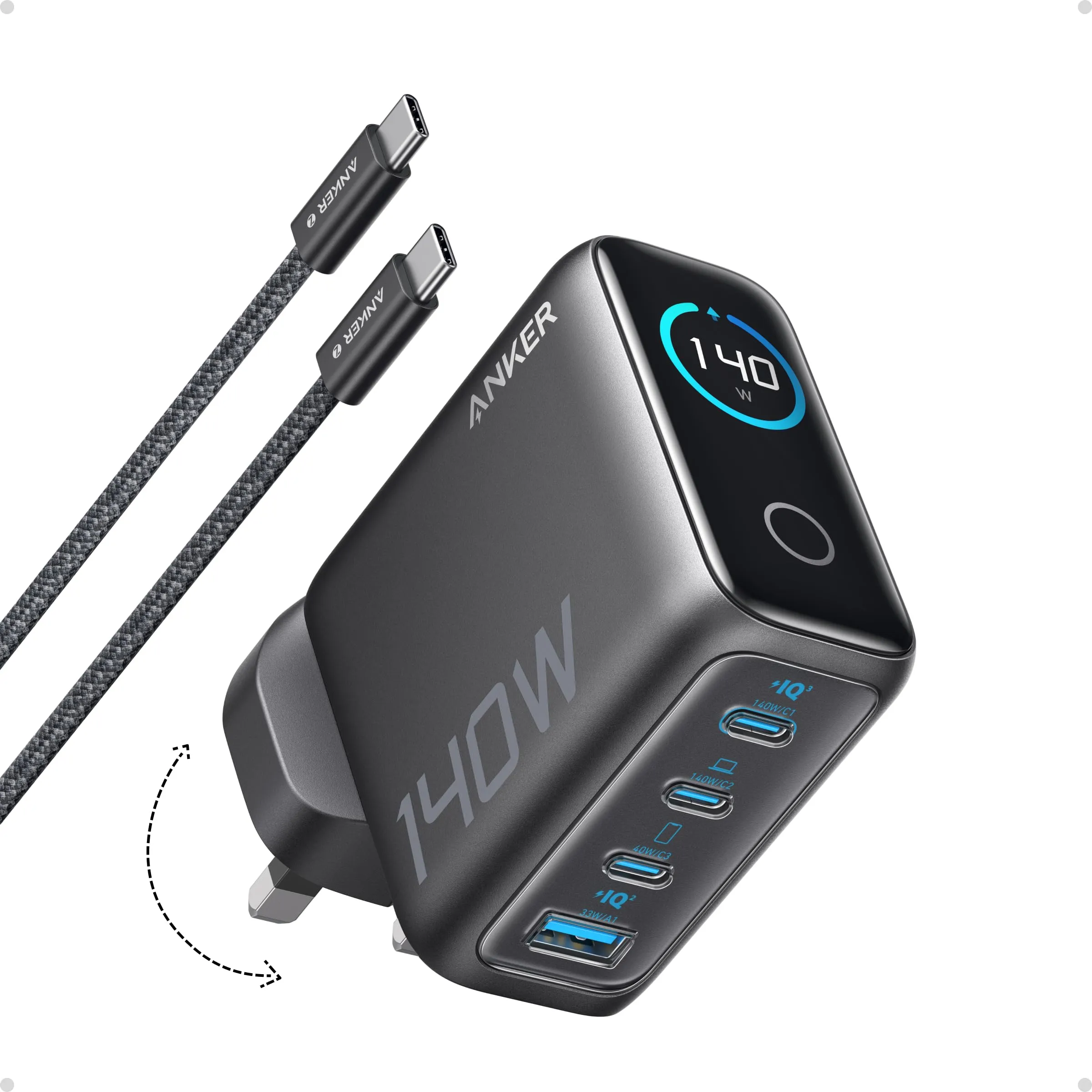
- 140WA 16-inch MacBook Pro and everything elseAnker 140W 4-port — PD 3.1, 70 + 70 W for two laptops, 295 g.
The six at a glance
| Model | Maximum output | Ports | Power sharing | Body size | Weight | Where to buy |
|---|---|---|---|---|---|---|
| Anker Nano 30Wfor a phone and nothing else | 30 W | 1 × USB-C | Single port — no sharing | 49 × 49 × 32 mm | 72.6 g | View listing |
| UGREEN Nexode 45W 2-portfor a Samsung and a second device | 45 W | 2 × USB-C | Not stated by UGREEN† | 50 × 50 × 42 mm | No confirmed data | View listing |
| UGREEN Nexode 65W 3-portfor a laptop, a phone and an old USB-A cable | 65 W | 2 × USB-C + 1 × USB-A | Not stated by UGREEN ('intelligent distribution')† | 57 × 50 × 46 mm | No confirmed data | View listing |
| Belkin BoostCharge Pro 65Wfor two USB-C devices with a stated split | 65 W | 2 × USB-C | 45 W + 20 W with both ports in use (top + bottom); 65 W alone | Not stated by Belkin† | No confirmed data | View listing |
| Anker 100W 3-portfor a laptop that wants the full 100 W | 100 W | 2 × USB-C + 1 × USB-A | C1 + C2: 70 + 30 or 95 + 5 W; C + A: 67 + 33 or 95 + 5 W; all three: 80 + 12 + 7.5 W | 69 × 55 × 34 mm† | 212 g† | View listing |
| Anker 140W 4-portfor a 16-inch MacBook Pro and everything else | 140 W | 3 × USB-C + 1 × USB-A | C1 + C2: 70 + 70 W; C + C3: 100 + 40 W; C + A: 100 + 33 W; three ports: 65 + 45 + 30 W | 69 × 69 × 36 mm | 295 g† | View listing |
Scroll sideways to see every column
† Figure from a retailer listing or otherwise awaiting confirmation from the manufacturer; other figures come from manufacturer manuals and leaflets.
Sizes are the charger body without the pins, as the makers state them, and only Anker publishes weights — UGREEN and Belkin do not. Two Anker pages contradict themselves on size or weight; we quote the body copy and mark the conflict. “Not stated” in the split column is the most important entry in the table: UGREEN’s UK pages describe “intelligent distribution” and give no figures, so a UGREEN with three things plugged in behaves in a way the maker has chosen not to tell you.
Why the split matters more than the headline
A 65 W charger is a 65 W charger for one device. Plug in a second and the total is shared, and the makers who publish the arithmetic show how unevenly: Belkin’s 65 W becomes 45 W plus 20 W; Anker’s 100 W becomes 70 plus 30, or 80 plus 12 plus 7.5 with three devices. A laptop on the 30 W or 12 W side of that will charge slowly or not at all while running, and a phone on a 5 W port will trickle. None of this is a fault — it is how the standard works — but it means the chargers to trust are the ones that print the numbers, and the number to buy is the one your two heaviest devices need at the same time.
Anker Nano 30W — for a phone and nothing else
for a phone and nothing else
Anker Nano 30W
- Maximum output
- 30 W
- Ports
- 1 × USB-C
- Power sharing
- Single port — no sharing
- Body size
- 49 × 49 × 32 mm
- Weight
- 72.6 g
Check price on Amazon.co.uk
The smallest thing here, and the honest answer for most people: one USB-C port, 30 W, 72.6 g, 49 × 49 × 32 mm before the pins, and the pins fold. Anker’s page gives the output table in full — 5 V at 3 A up to 20 V at 1.5 A — and says it supports PPS, which is the protocol Samsung phones need for their fast mode and iPhones ignore. At 30 W it charges any current phone at that phone’s maximum, an iPad at a sensible speed and a pair of earbuds without being asked.
What it does not do is the box-of-plugs job for a household. One port means one device, and 30 W is not a laptop figure — a MacBook Air will take it, slowly, and complain under load. Anker’s page describes the warranty only as hassle-free; the Amazon listing says 24 months. No cable is included, which for a phone charger you already own three of is the correct decision.
Buy it as the bedside or coat-pocket charger next to one of the bigger ones, or as the only charger for someone who owns a phone and nothing that plugs into USB-C besides.
Strengths
- 72.6 g with folding pins — the smallest thing here
- 30 W with PPS covers any current phone at full speed
- GaN body 29 % smaller than Anker's old 20 W brick
Limitations
- One port: the box of plugs does not shrink if you own three devices
- Not enough for Samsung's 45 W 'Super fast charging 2.0' or any laptop
- No cable in the box
Good for
- one phone, charged overnight or fast
- the coat pocket
- a bedside socket
Look elsewhere if
- a laptop or a tablet at full speed
- two devices at once
UGREEN Nexode 45W — for a Samsung and a second device
for a Samsung and a second device
UGREEN Nexode 45W 2-port
- Maximum output
- 45 W
- Ports
- 2 × USB-C
- Power sharing
- Not stated by UGREEN†
- Body size
- 50 × 50 × 42 mm
Check price on Amazon.co.uk
The 45 W figure is not arbitrary: it is what Samsung’s larger phones ask for to show “Super fast charging 2.0”, and the UGREEN gives it from either of two USB-C ports with PPS, in a 50 × 50 × 42 mm body with folding pins, for a two-year warranty. UGREEN’s list of protocols is long — PD 3.0, PPS, QC 4.0 down to 2.0, FCP, AFC, Apple and Samsung 5 V modes — which is a way of saying it will negotiate with almost anything made in the last decade.
The thing UGREEN does not say is how the two ports share the 45 W. A customer review on UGREEN’s own page suggests 25 plus 20, but that is a customer, not a specification, so we treat the second port as a slot for earbuds or a watch rather than a second phone at speed. Weight is not stated either, and there is no cable or USB-A port.
For a Samsung owner with earbuds it is the right size; for anyone with a laptop it is the wrong one.
Strengths
- 45 W with PPS — the level Samsung's 'Super fast charging 2.0' asks for
- Two USB-C ports with folding pins
- Two-year warranty
Limitations
- UGREEN does not publish the two-port split — assume a phone plus earbuds, not two phones at speed
- No cable; no USB-A for older leads
- Weight not stated
Good for
- a Samsung phone and earbuds or a watch
- a bedside with two devices
- a small tablet
Look elsewhere if
- a laptop
- two phones both wanting fast charge
UGREEN Nexode 65W — for a laptop, a phone and an old USB-A cable
for a laptop, a phone and an old USB-A cable
UGREEN Nexode 65W 3-port
- Maximum output
- 65 W
- Ports
- 2 × USB-C + 1 × USB-A
- Power sharing
- Not stated by UGREEN ('intelligent distribution')†
- Body size
- 57 × 50 × 46 mm
Check price on Amazon.co.uk
This is the shape most people picture when they think of “one charger for the bag”: two USB-C ports and one USB-A, 65 W, folding pins, 57 × 50 × 46 mm. Alone, 65 W runs a MacBook Air or a 13-inch MacBook Pro at full speed and most 65 W Windows laptops too — UGREEN’s page claims a MacBook Air M4 from empty to half in 30 minutes. The USB-A port is the concession to reality: the watch charger, the Kindle cable and the bike light all still end in USB-A.
The protocol list covers PD 3.0 and PPS on the USB-C ports, so Samsung fast charging works, plus QC 4+ and the Huawei and Samsung legacy modes. Two-year warranty. What UGREEN’s UK page does not state is the multi-port split — “power is split optimally across the 3 ports” is the whole of it — or the weight. In use that means a laptop and a phone together will each get less than you might guess, and you will not know how much less until you try. No cable in the box.
If you want the three-port shape and can live with the missing figures, this is the compact version of it. If you want the figures, read on.
Strengths
- 65 W single-port — a MacBook Air or most 65 W laptops at full speed
- A USB-A port for the old cables you still own
- Folding pins; two-year warranty
Limitations
- UGREEN does not publish how 65 W is shared across three ports
- No cable in the box
- Weight not stated
Good for
- a laptop plus a phone on a desk
- one charger for a weekend bag
- someone with a USB-A watch charger
Look elsewhere if
- a 16-inch MacBook Pro or a gaming laptop
- anyone who needs the multi-port figures in writing — see the Belkin
Belkin BoostCharge Pro 65W — for two USB-C devices with a stated split
for two USB-C devices with a stated split
Belkin BoostCharge Pro 65W
- Maximum output
- 65 W
- Ports
- 2 × USB-C
- Power sharing
- 45 W + 20 W with both ports in use (top + bottom); 65 W alone
- Body size
- Not stated by Belkin†
Check price on Amazon.co.uk
Belkin publishes the number the others leave out. Alone, either port gives up to 65 W; with both in use, the top port gives up to 45 W and the bottom up to 20 W — a laptop and a phone at known, sensible speeds. Both ports support PD 3.0 and PPS, so a Samsung gets its fast mode from the 45 W side. Belkin adds a footnote worth knowing: the full 45 W on the top port needs the second port free of a USB-C-to-Lightning cable.
What Belkin does not publish is the rest: no dimensions, no weight, and no statement about whether the pins fold — so the “compact” in the category name is Belkin’s word and we cannot check it against the others. There is no USB-A port and no cable in the box. Two-year warranty.
Choose it if you value documented behaviour over the last few millimetres, and if everything you own has moved to USB-C.
Strengths
- The split is stated: 45 W + 20 W — you know what the phone gets
- PD 3.0 and PPS on both ports
- Two-year warranty
Limitations
- No USB-A
- Belkin does not state size, weight or whether the pins fold
- 45 W on the top port drops if a Lightning cable is in the bottom one
Good for
- a laptop and a phone on one socket
- someone who wants documented behaviour
- a USB-C-only household
Look elsewhere if
- old USB-A cables
- pocket travel where size matters — the dimensions are unknown
Anker 100W 3-port — for a laptop that wants the full 100 W
for a laptop that wants the full 100 W
Anker 100W 3-port
- Maximum output
- 100 W
- Ports
- 2 × USB-C + 1 × USB-A
- Power sharing
- C1 + C2: 70 + 30 or 95 + 5 W; C + A: 67 + 33 or 95 + 5 W; all three: 80 + 12 + 7.5 W
- Body size
- 69 × 55 × 34 mm†
- Weight
- 212 g†
Check price on Amazon.co.uk
The step up to 100 W is for the 14-inch MacBook Pro and the 90–100 W Windows laptops that shrug at 65 W. Anker’s page gives both the single-port figures (100 W on either USB-C, 33 W on the USB-A) and every split: 70 plus 30 W for two USB-C devices, or 95 plus 5; 67 plus 33 with the USB-A; 80, 12 and 7.5 W with all three, USB-C1 taking priority. A touch display on the body shows what each port is drawing, which turns the arithmetic into something you can see.
The pins fold, and a USB-C cable is in the box — Anker notes that the full 100 W needs a cable rated for it. Two figures on Anker’s own page disagree with each other: the body copy gives 69 × 55 × 34 mm and 212 g excluding the plug, while the specification table says 15 × 11 × 5.5 cm and 74 g, which reads like the packaging; we quote the body copy and mark the conflict. PPS is not stated for this model, so a Samsung owner should check before buying it as the phone’s charger too. Anker’s warranty is described only as hassle-free.
At this size it is a desk charger that travels, not a pocket charger.
Strengths
- 100 W single-port and a printed split for every combination
- Touch display shows what each port is drawing
- Folding pins; cable in the box
Limitations
- Anker's page contradicts itself on size and weight
- PPS not stated — check before buying it for a Samsung
- Needs a 100 W-rated cable for the headline figure
Good for
- a 14-inch MacBook Pro or 90–100 W Windows laptop plus a phone
- a desk that charges three things
- people who like to see the numbers
Look elsewhere if
- a 16-inch MacBook Pro at full speed (140 W)
- the smallest possible bag
Anker 140W 4-port — for a 16-inch MacBook Pro and everything else
for a 16-inch MacBook Pro and everything else
Anker 140W 4-port
- Maximum output
- 140 W
- Ports
- 3 × USB-C + 1 × USB-A
- Power sharing
- C1 + C2: 70 + 70 W; C + C3: 100 + 40 W; C + A: 100 + 33 W; three ports: 65 + 45 + 30 W
- Body size
- 69 × 69 × 36 mm
- Weight
- 295 g†
Check price on Amazon.co.uk
The 16-inch MacBook Pro ships with a 140 W adapter, and this is the only charger here that matches it, using USB PD 3.1’s 28 V level on either of two USB-C ports. Anker’s split table is the most complete in the group: 70 plus 70 W for two laptops, 100 plus 40 or 100 plus 33 with the third USB-C or the USB-A, 65 plus 45 plus 30 with three devices, and 134 W total with all four ports busy. Protocols run from PD 3.1 through PPS to the legacy Quick Charge and Huawei modes; a touch display shows the draw.
Two conditions. Anything above 100 W needs an E-Marker cable rated for it — the one in the box qualifies — and Anker says Dell laptops are capped at 60 W by Dell’s own protocol. Weight is stated as 295 g in Anker’s body copy and spec sheet and 395 g in the UK table (with the cable, presumably); the body is 69 × 69 × 36 mm, the pins fold, and the warranty is not stated on the UK page.
This is the household charging station: it lives by the desk or the sofa and replaces the laptop brick, the tablet charger and the phone charger together. It does not go in a jacket.
Strengths
- 140 W via PD 3.1 — the full speed of a 16-inch MacBook Pro
- 70 + 70 W: two laptops at once, splits printed for every combination
- Three USB-C and a USB-A with folding pins
Limitations
- 295 g (395 g with cable, per Anker's table) — it stays on the desk
- Above 100 W only with an E-Marker cable
- Dell laptops are capped at 60 W by Anker's own note
Good for
- a 16-inch MacBook Pro or two laptops
- the household charging station
- replacing the laptop's own brick
Look elsewhere if
- a bag — the 30 W or 65 W chargers travel
- Dell owners expecting the full figure
How to choose
- Add up the two heaviest things you charge at once. Phone plus earbuds: 30–45 W. Laptop plus phone: 65 W with a stated split (Belkin) or 100 W (Anker). Two laptops or a 16-inch MacBook Pro: 140 W.
- Samsung? You want PPS stated: Anker 30 W, both UGREENs, Belkin, Anker 140 W. Not stated on the Anker 100 W.
- Any USB-A left in your life? UGREEN 65 W, Anker 100 W, Anker 140 W have one port; the others are USB-C only.
- Bag or desk? Folding pins and under 75 g: Anker 30 W. Folding pins and about 50 mm square: both UGREENs. Desk: the Anker 100 W and 140 W.
- Cables. None in the UGREEN or Belkin boxes; the Anker 100 W and 140 W include one, and need a 100 W (5 A) or E-Marker cable respectively for their headline figures.
Buy from the brand’s own listing with an explicit UK plug. Electrical Safety First’s advice is to buy USB chargers from a reputable retailer rather than a third-party seller, and the Amazon listings for these products mix fixed UK-plug models with “travel” kits that ship interchangeable EU and US heads — check the plug in the photos before you order.
Who should not buy a new charger
If your only USB-C device is a phone and its charger still works, nothing here improves your life except the folding pins. If you fly with a power bank, note that the Civil Aviation Authority’s rules — cabin bag only, two per person, under 100 Wh without asking — are about batteries, not mains chargers; a GaN brick has no such limit. And if you own a Dell laptop above 60 W, check Dell’s own adapter before assuming any third-party charger will run it at full speed.
Which one, by situation
- Phone only: Anker Nano 30W.
- Samsung phone plus earbuds: UGREEN Nexode 45W.
- Laptop, phone, and a USB-A watch cable in a bag: UGREEN Nexode 65W.
- Laptop and phone, and you want to know what each gets: Belkin BoostCharge Pro 65W.
- 14-inch MacBook Pro or a 100 W Windows laptop: Anker 100W, with a 100 W-rated cable.
- 16-inch MacBook Pro, or two laptops on one socket: Anker 140W.
Sources
Facts checked 23 September 2026
- Samsung UK support — How to use Super fast charging — Manufacturer documentation, checked 23 September 2026
- Anker support — Why does my Samsung phone not show 'Super fast charging 2.0' — Manufacturer documentation, checked 23 September 2026
- UK Civil Aviation Authority — Pack right. Safe flight. — Standard or regulation, checked 23 September 2026
- Electrical Safety First — USB chargers guidance — Standard or regulation, checked 23 September 2026
- Anker UK — Nano USB-C Wall Charger (30W) A2337 product page — Manufacturer documentation, checked 23 September 2026
- Amazon.co.uk listing (Anker) — Retailer listing, checked 23 September 2026
- UGREEN UK — Nexode 45W 2-Port Charger (SKU 90399) product page — Manufacturer documentation, checked 23 September 2026
- Amazon.co.uk listing (UGREEN) — Retailer listing, checked 23 September 2026
- UGREEN UK — Nexode 65W 3-Port Charger with Foldable Plug (SKU 90663) product page — Manufacturer documentation, checked 23 September 2026
- Amazon.co.uk listing (UGREEN) — Retailer listing, checked 23 September 2026
- Belkin UK — BoostCharge Pro Dual USB-C GaN Wall Charger with PPS 65W (WCH013) product page — Manufacturer documentation, checked 23 September 2026
- Amazon.co.uk listing (Belkin) — Retailer listing, checked 23 September 2026
- Anker UK — Charger (100W, 3 Ports, Smart Display) B121B product page — Manufacturer documentation, checked 23 September 2026
- Amazon.co.uk listing (Anker) — Retailer listing, checked 23 September 2026
- Anker UK — Charger (140W, 4-Port, PD 3.1) with USB-C Cable A2697/B2697 product page and spec sheet (service.anker.com) — Manufacturer documentation, checked 23 September 2026
- Amazon.co.uk listing (Anker) — Retailer listing, checked 23 September 2026
Will a 65 W or 100 W charger damage my phone?
No. USB-C Power Delivery is a negotiation: the phone asks for what it can take and the charger supplies that and no more, so a 100 W charger gives a phone the same 20-odd watts as a phone charger would. Which? puts it plainly — a phone only takes the maximum power it is capable of charging at, so a higher-wattage charger will not damage it. What can matter is the cable and the protocol: a Samsung needs PPS for its fastest mode, and a laptop needs a cable rated for the current.
Why does my Samsung say 'Fast charging' but not 'Super fast charging'?
Samsung's Super fast charging needs three things at once: a charger that supports PPS, at least 25 W (45 W for 'Super fast charging 2.0' on the larger phones), and — on most models — a 5 A e-marked USB-C cable. Samsung's own support page says it cannot be done with standard chargers. Anker adds that its 45 W chargers show 'Super fast charging' rather than '2.0' because of protocol labelling, that the label can disappear when several ports are in use because the single port's wattage drops, and that the total charge time is almost identical to Samsung's own 45 W adapter. Every charger here except the Anker 100 W states PPS.
Can I charge a MacBook with a phone charger?
Slowly, and not while you work hard on it. A 20 or 30 W charger will top up a MacBook Air overnight, but under load it will not keep up, and a MacBook Pro will drain while plugged in. A 65 W charger runs a MacBook Air or a 13-inch Pro at full speed; the 14-inch Pro wants 96 to 100 W; the 16-inch Pro's own adapter is 140 W, which only the PD 3.1 charger here matches.
What cable do I need for 100 W or 140 W?
USB-C cables carry a current rating. A basic cable is 3 A — 60 W at 20 V — and will quietly cap a laptop at 60 W. A 5 A cable with an e-marker chip carries 100 W and is what Anker says its 100 W charger needs for the full figure; for anything above 100 W, including the 140 W port here, Anker requires an E-Marker cable rated for PD 3.1's 28 V, sold as 140 W or 240 W cables. The cables in the Anker boxes are the right ones for their charger; the UGREEN and Belkin boxes contain no cable.