Shortlist · Charging & power · 6 models
Power banks for everyday travel: six from a 122 g magnetic slab to a 99.75 Wh laptop brick, plus the 2026 flight rules
A power bank is sold by a number that is not the one that matters. The milliamp-hours on the box are cell capacity; roughly two-thirds reaches your phone, and the airline cares about watt-hours, which most makers do not print. Six banks compared on stated Wh, delivered capacity, port wattage and weight — plus the CAA rules that tightened on 27 March 2026.
Quick answer
- 5000mAhA pocket and a MagSafe iPhoneAnker Nano 5K MagGo — 122 g, 8.6 mm, Qi2 15 W wireless, about one charge.
- 10,000mAhA Samsung and a bag pocketINIU P41 — 10,000 mAh, 45 W from one USB-C port, 182 g, three-year warranty.
- 10,000mAhPeople who forget cablesAnker Nano 10K — the USB-C cable is built in as a loop, 30 W in and out, a display.
- 20,000mAhGalaxy owners who want the Wh printedSamsung 20,000 mAh — 74 Wh stated, 45 W Super Fast Charging 2.0, three ports.
- 20,000mAhA laptop on a trainUGREEN Nexode 100 W — 72 Wh and 11,300 mAh delivered, both printed; 65 W recharge.
- 26,250mAhThe biggest bank that flies without askingAnker Prime 26K — 99.75 Wh stated, 140 W per port, 600 g.
The six at a glance
| Model | Capacity | Energy | Max output | Weight | Built-in cable | Where to buy |
|---|---|---|---|---|---|---|
| Anker Nano 5K MagGo Slimfor a pocket and a MagSafe iPhone | 5000 mAh | 18.5 Wh† | 20 W | 122 g | No | View listing |
| INIU P41 10,000 mAh 45 Wfor a Samsung and a bag pocket | 10,000 mAh | 37 Wh† | 45 W | 182 g | 0.12 m detachable USB-C lanyard cable | View listing |
| Anker Nano 10K with built-in cablefor people who forget cables | 10,000 mAh | 37 Wh† | 30 W | 215 g | USB-C, doubles as a carry loop | View listing |
| Samsung 20,000 mAh 45 W battery packfor Galaxy owners who want the Wh printed | 20,000 mAh | 74 Wh | 45 W | 402 g† | No — 0.3 m C-to-C cable in the box | View listing |
| UGREEN Nexode 20,000 mAh 100 Wfor a laptop on a train | 20,000 mAh | 72 Wh | 100 W | 420 g | No | View listing |
| Anker Prime 26K 300 Wfor the biggest bank that flies without asking | 26,250 mAh | 99.75 Wh | 140 W | 600 g | No | View listing |
Scroll sideways to see every column
† Figure from a retailer listing or otherwise awaiting confirmation from the manufacturer; other figures come from manufacturer manuals and leaflets.
Watt-hours are marked where the maker does not print them: Anker’s Nano banks and INIU state milliamp-hours only, so their Wh is computed at 3.7 V and flagged. Samsung’s 74 Wh comes from its US specification page; UGREEN’s 72 Wh and Anker’s 99.75 Wh are on their own pages. Weights are the makers’ — Samsung’s differs from the listing’s by 52 g and we record the conflict.
The two numbers that are not on the box
Delivered capacity. Cells store energy at about 3.6–3.7 V; a phone takes it at 5 V or more, through a converter and a cable, and 30 to 45 per cent of the energy is lost on the way (Anker’s figure). So a 20,000 mAh bank is an 11,300 mAh bank by the time it reaches the phone — UGREEN’s own numbers, printed side by side, which is rare and creditable. Rule of thumb: divide the box figure by 1.6 and then by your phone’s battery to get charges.
Watt-hours. This is the airline number. The CAA’s formula is (V × mAh) ÷ 1000; at 3.7 V a 10,000 mAh bank is 37 Wh, 20,000 mAh is 74 Wh, and 26,250 mAh is about 97 Wh — Anker’s Prime prints 99.75 Wh, which implies a higher cell voltage and puts it as close to the 100 Wh no-approval line as a bank can get. Since 27 March 2026 the UK rules are: two banks per person, cabin only, no recharging on board, no charging devices on board, individually protected, under 100 Wh without approval. Ryanair wants them on you or under the seat, not in the locker. A printed Wh figure is worth paying for if you fly.
Anker Nano 5K MagGo — for a pocket and a MagSafe iPhone
for a pocket and a MagSafe iPhone
Anker Nano 5K MagGo Slim
- Capacity
- 5000 mAh
- Energy
- 18.5 Wh†
- Max output
- 20 W
- Weight
- 122 g
- Built-in cable
- No
Check price on Amazon.co.uk
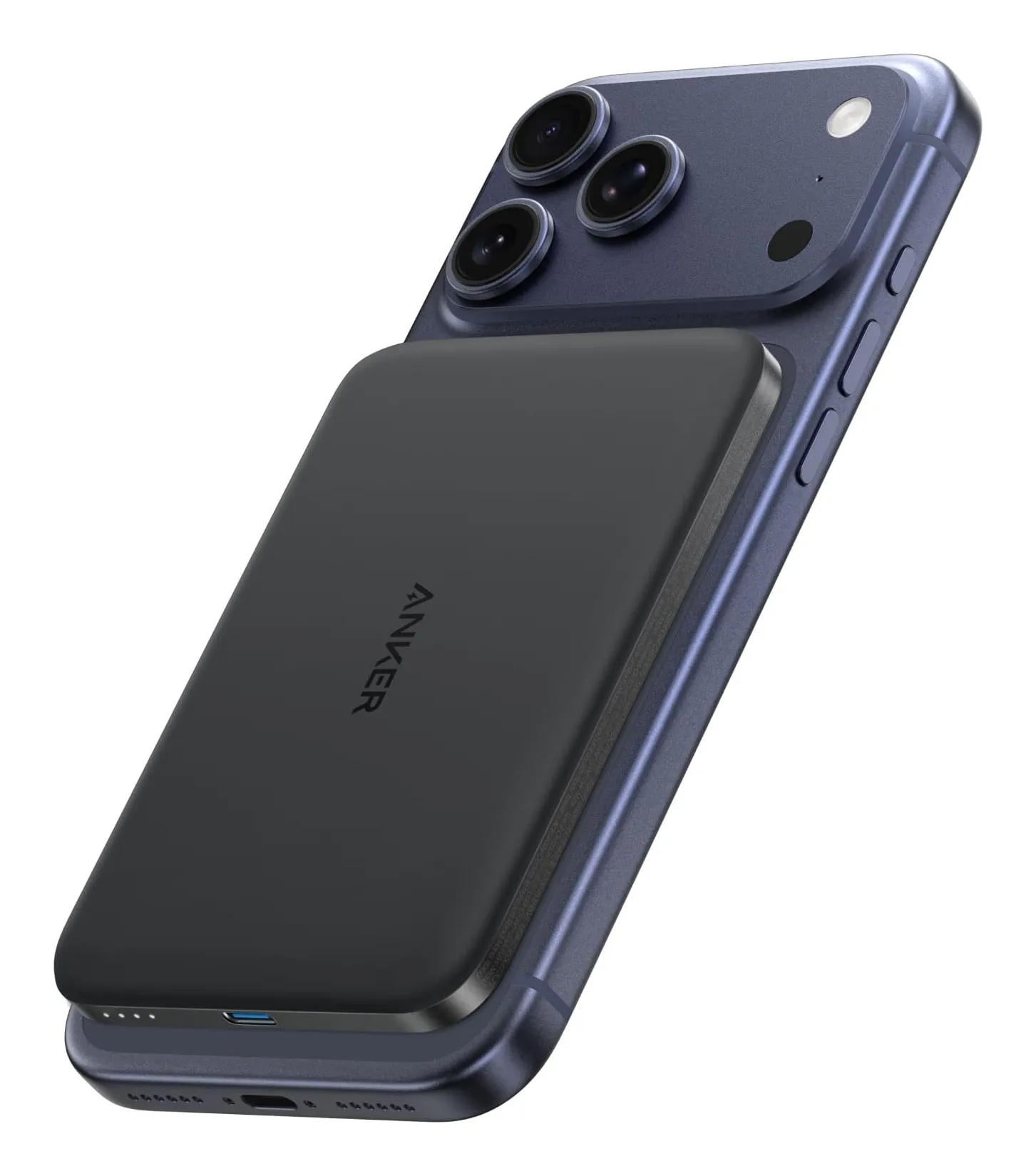
The MagGo is the bank you carry when you did not mean to carry a bank: 102 × 70.6 × 8.6 mm, 122 g, magnetic. It snaps to the back of a MagSafe iPhone and charges it wirelessly at up to 15 W under the Qi2 standard, or through its single USB-C port at 20 W; that port also recharges the bank, from empty in under two hours with a 20 W charger and a 3 A cable. Anker rates it at 5,000 mAh and, unusually, tells you what that means: an estimated 2,750 to 3,500 mAh delivered, or roughly one charge of a current iPhone.
Anker does not print the watt-hours; at 3.7 V the 5,000 mAh cells are about 18.5 Wh, far under any limit. Anker lists the phones it will not fit — the iPhone 16e, the 12 and 13 mini and the SE — and describes the warranty only as hassle-free (the listing says 18 months).
This is a day-out bank, not a travel bank: one top-up, no cable to carry, and the phone stays usable while it charges. For a weekend, two devices or an Android without magnets, move down the list.
Strengths
- 8.6 mm and 122 g — a pocket, not a bag
- Qi2 magnetic 15 W wireless plus 20 W USB-C
- Recharges in under two hours
Limitations
- 5,000 mAh delivers roughly 2,750–3,500 mAh to a phone — one charge, not two
- Anker states no Wh figure; the ~18.5 Wh is computed
- Not for the smaller iPhones Anker lists
Good for
- a MagSafe iPhone and a day out
- a pocket or small bag
- anyone who hates cables
Look elsewhere if
- a tablet or laptop
- two full phone charges
INIU P41 — for a Samsung and a bag pocket
for a Samsung and a bag pocket
INIU P41 10,000 mAh 45 W
- Capacity
- 10,000 mAh
- Energy
- 37 Wh†
- Max output
- 45 W
- Weight
- 182 g
- Built-in cable
- 0.12 m detachable USB-C lanyard cable
Check price on Amazon.co.uk
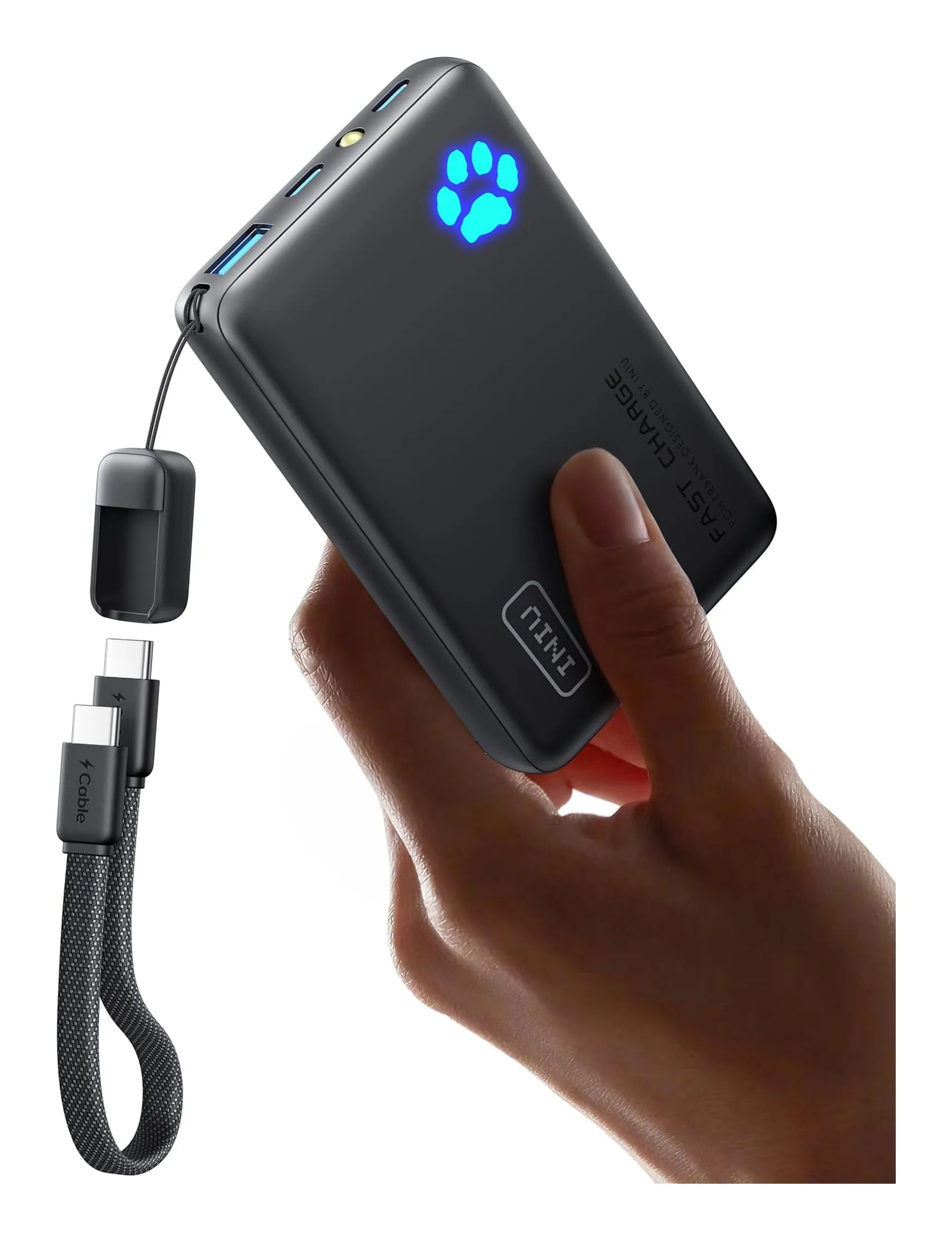
The INIU’s number is 45 W: from either of its two USB-C ports it will run a Samsung’s Super Fast Charging or keep a MacBook Air alive, from a 10,000 mAh bank that weighs 182 g and measures 11 × 6.7 × 1.8 cm. There is a USB-A port for old cables, a 12 cm detachable USB-C lanyard cable, a torch, and PD 3.0 with PPS in the protocol list. INIU’s warranty is three years — the longest in this article — with a 30-day money-back period.
The catch is in INIU’s own spec: use two ports at once and the total output falls to 15 W. This is a one-device-at-a-time bank, and the second port is for the earbuds afterwards. Recharge input is 27 W; INIU states no time. INIU does not print watt-hours either — about 37 Wh computed — so at a strict gate you would be explaining arithmetic.
For a commute, a day trip and a Samsung that wants its fast mode, it is the best value for weight here. The Amazon listing is the P41-E2 variant; INIU also sells a P50, a different model — check the code.
Strengths
- 45 W from one USB-C port at 182 g
- Three-year warranty; short lanyard cable attached
- Two USB-C plus USB-A
Limitations
- Plug in two devices and the total falls to 15 W
- No Wh printed by INIU — compute and be ready to explain at security
- 27 W recharge input
Good for
- a commute and a day trip
- a Samsung owner who wants Super Fast Charging on the move
- a bag pocket
Look elsewhere if
- charging two things fast at once
- a laptop for a working day
Anker Nano 10K with built-in cable — for people who forget cables
for people who forget cables
Anker Nano 10K with built-in cable
- Capacity
- 10,000 mAh
- Energy
- 37 Wh†
- Max output
- 30 W
- Weight
- 215 g
- Built-in cable
- USB-C, doubles as a carry loop
Check price on Amazon.co.uk
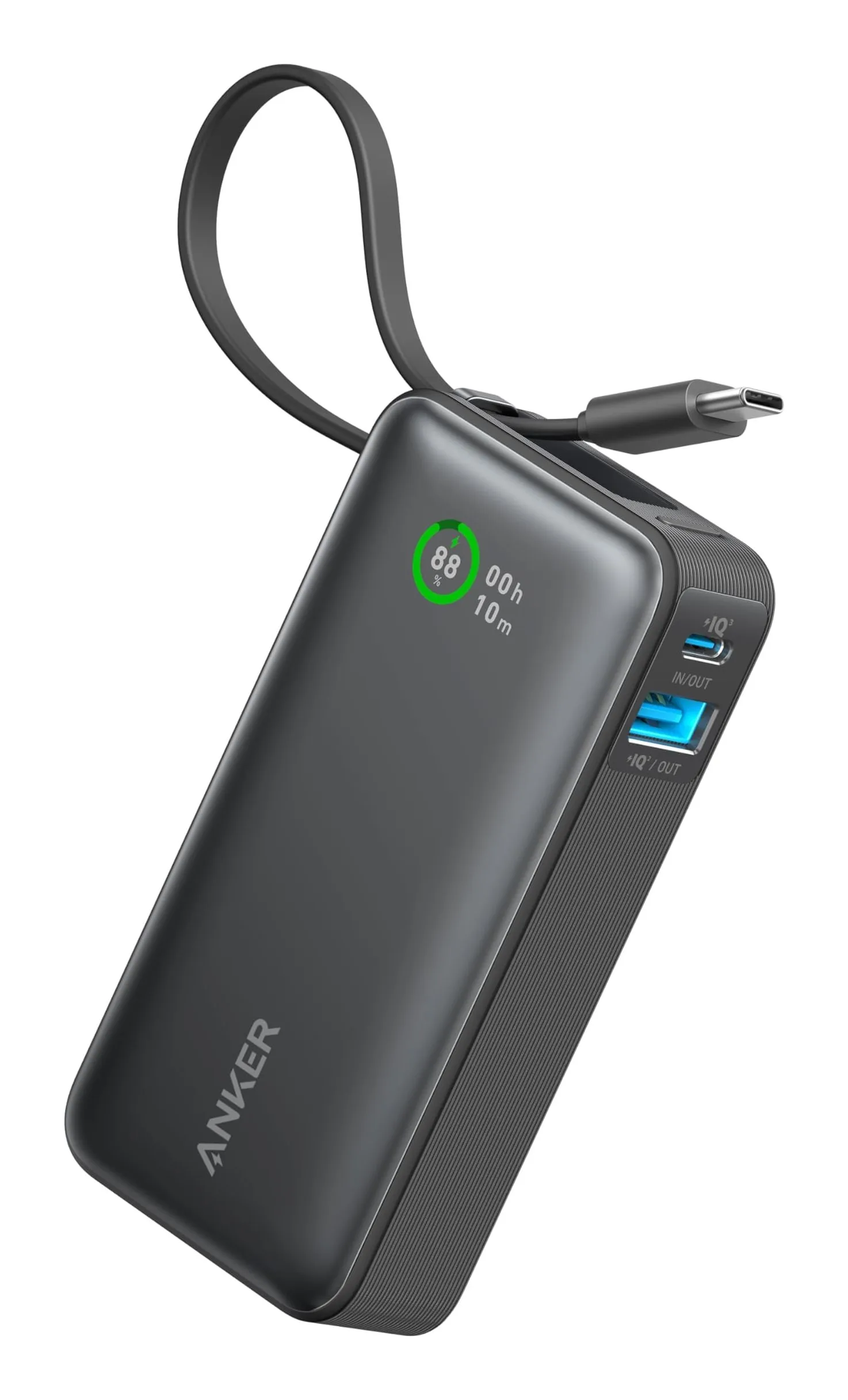
Anker’s answer to the forgotten cable is to build it in: a short USB-C cable is fixed to the body and doubles as a carry loop, alongside a USB-C port and a USB-A port. Output is 30 W from the cable or the port and 22.5 W from USB-A, with a total of 24 W when several devices share; input is 30 W, which Anker says gets the bank to half in about 45 minutes. A colour display shows the percentage rather than four dots.
The price of the cable and the display is bulk: 104 × 52.3 × 26 mm and 215 g, chunkier than the INIU for the same nominal 10,000 mAh (about 37 Wh, computed — Anker states no Wh). Anker’s warranty is hassle-free, 18 months per the listing. One clarification worth making: this is the A1259, not the A1257 that Anker recalled in the United States in 2025; none of the banks in this article is on Anker’s UK recall list.
For a phone and earbuds in a bag, with no cable to lose and a readout you can trust, it is the pragmatic 10K.
Strengths
- Built-in USB-C cable — nothing to forget
- 30 W out and 30 W in; half full in about 45 minutes
- Display shows the real percentage
Limitations
- 215 g and 26 mm thick — chunkier than the INIU
- Total drops to 24 W with two devices
- No Wh stated by Anker
Good for
- a bag that never has the right cable
- a phone and earbuds
- someone who wants a percentage readout
Look elsewhere if
- laptop charging
- a slim pocket
Samsung 20,000 mAh 45 W — for Galaxy owners who want the Wh printed
for Galaxy owners who want the Wh printed
Samsung 20,000 mAh 45 W battery pack
- Capacity
- 20,000 mAh
- Energy
- 74 Wh
- Max output
- 45 W
- Weight
- 402 g†
- Built-in cable
- No — 0.3 m C-to-C cable in the box
Check price on Amazon.co.uk
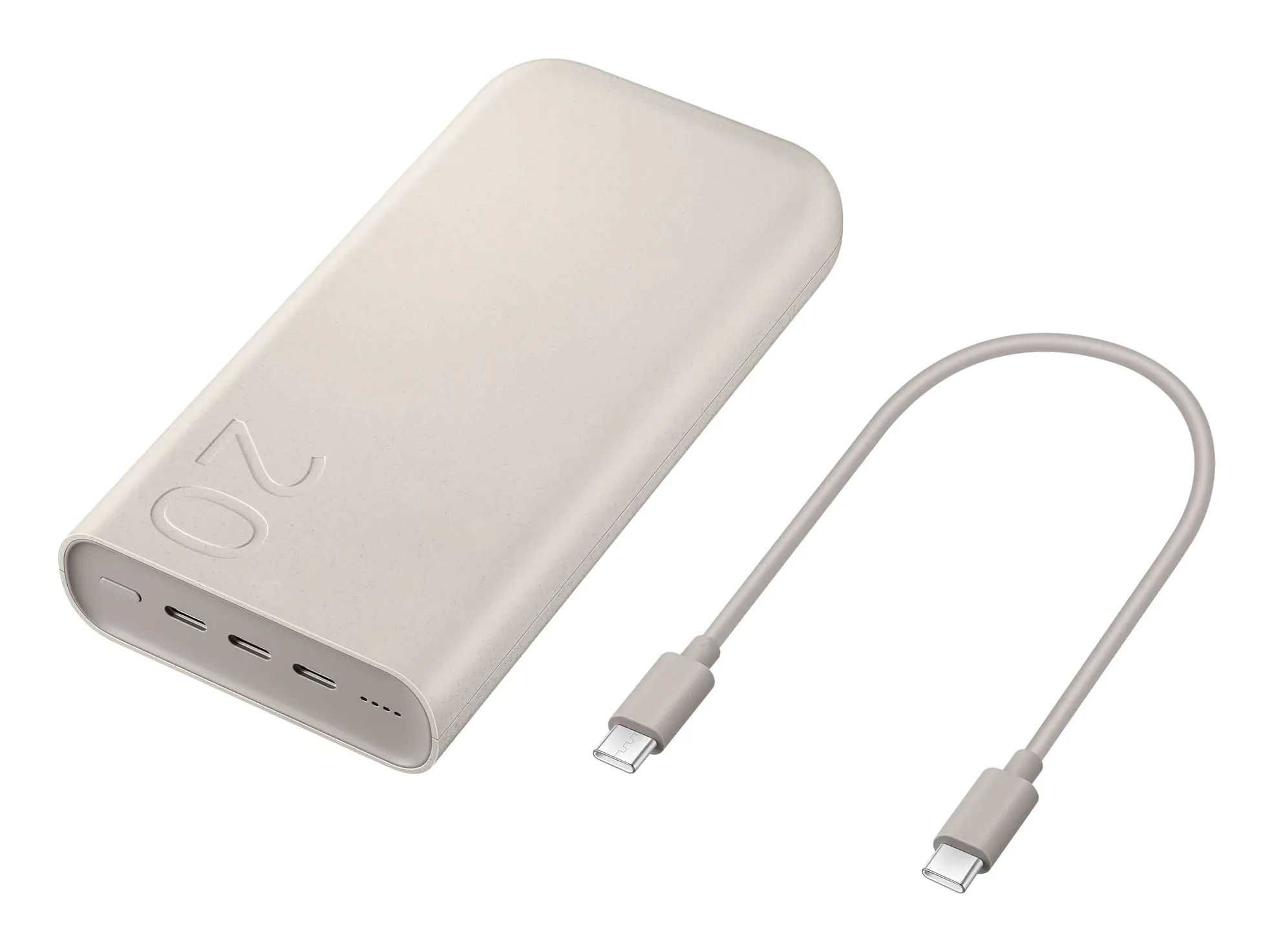
Samsung’s own battery pack is here for two reasons: it speaks Galaxy — 45 W Super Fast Charging 2.0 with PD 3.0 PDO and PPS — and it prints its capacity in watt-hours, 74 Wh, on the specification page. Three ports (the listing says three USB-C), a 0.3 m C-to-C cable in the box, 152 × 76 × 25.5 mm, and 402 g by Samsung’s UK page (the listing says 350 g; we record the conflict).
What Samsung does not publish is as notable: no per-port split, no input wattage or recharge time, no warranty period on the page. The 45 W is the phone’s number; for a laptop it is a trickle. And 402 g is a lot to carry for a phone bank when the INIU does 45 W at 182 g.
Buy it for a Galaxy household that wants the manufacturer’s own accessory and a Wh figure on the case, and for the reassurance that comes with both.
Strengths
- 74 Wh stated by Samsung — no arithmetic at the gate
- 45 W with PPS, the Galaxy fast-charge standard
- Three ports, cable in the box
Limitations
- 402 g
- Samsung does not publish the per-port split, input wattage or warranty
- 45 W is a phone figure, not a laptop one
Good for
- Galaxy owners
- a weekend away
- a family's phones on a day out
Look elsewhere if
- a laptop
- a jacket pocket
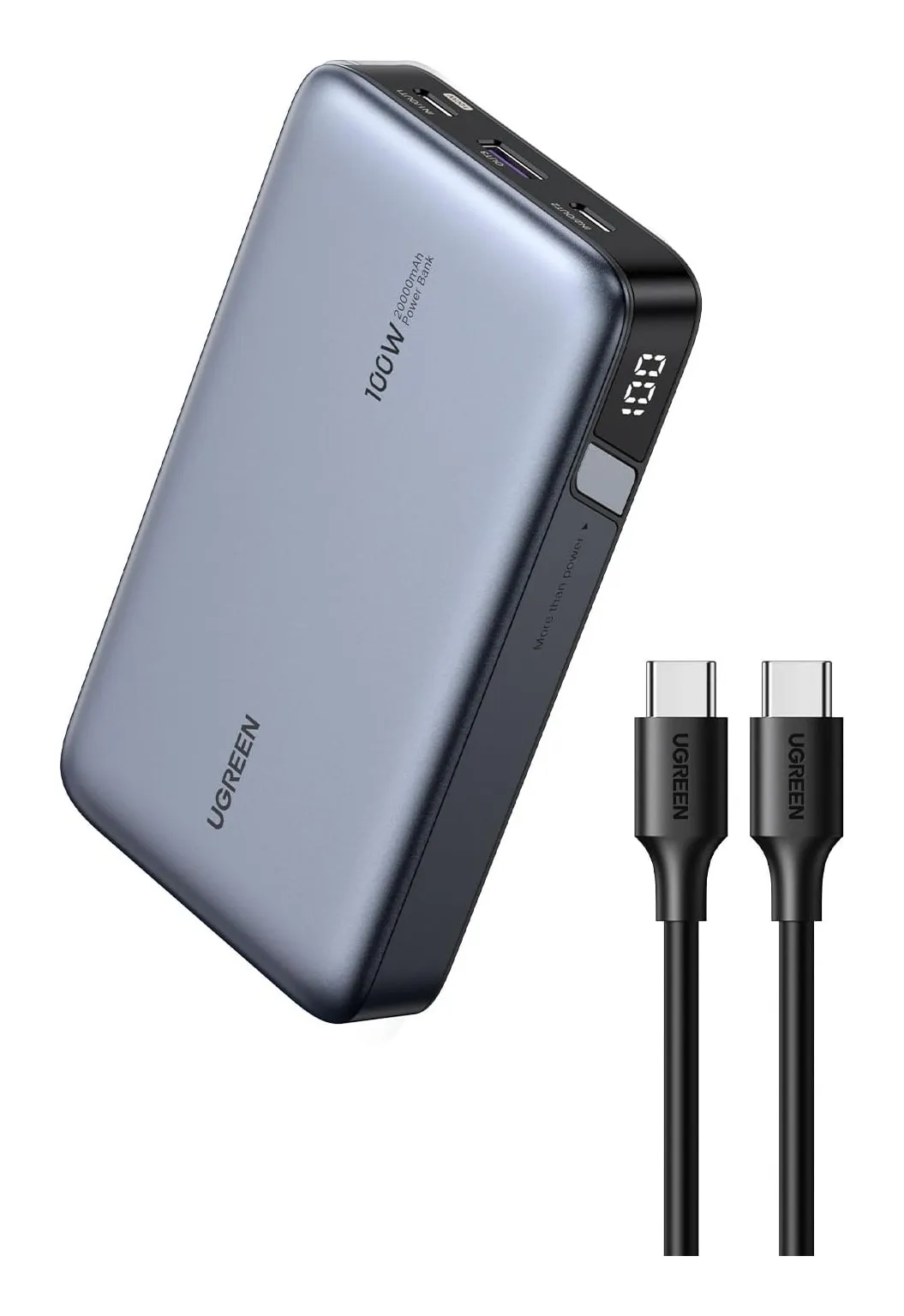
UGREEN Nexode 100 W — for a laptop on a train
for a laptop on a train
UGREEN Nexode 20,000 mAh 100 W
- Capacity
- 20,000 mAh
- Energy
- 72 Wh
- Max output
- 100 W
- Weight
- 420 g
- Built-in cable
- No
Check price on Amazon.co.uk
The UGREEN is the honest laptop bank. Its specification table prints 20,000 mAh at 3.6 V (72 Wh) and, on the next line, the rated capacity actually delivered: 11,300 mAh at 5 V. USB-C1 gives 100 W — enough for a 14-inch MacBook Pro or any 65–100 W Windows laptop — USB-C2 gives 30 W and USB-A 22.5 W. It takes 65 W back in and refills in 1.6 hours, with pass-through charging, so it can sit between the wall and the laptop overnight. An LED display shows the charge; 139 × 80 × 26.5 mm; 420 g; two-year warranty.
The trade-offs are those of any 20,000 mAh bank: 420 g and the size of a paperback, and the second USB-C port is a phone port, not a second laptop port. The protocols cover PD 3.0 with PPS, so a Samsung fast-charges from it too.
For a working day away from sockets — a train, a library, a café with no tables near the wall — this is the one, and the printed 72 Wh means no questions at the gate.
Strengths
- 100 W single-port — a MacBook Pro or any USB-C laptop
- UGREEN states 72 Wh and the delivered 11,300 mAh
- 65 W recharge in 1.6 hours with pass-through
Limitations
- 420 g
- Second USB-C port is 30 W only
- Bulkier than the phone banks
Good for
- a laptop on a train
- a long day with phone and laptop
- someone who wants the Wh printed
Look elsewhere if
- a pocket
- a phone-only owner
Anker Prime 26K 300 W — for the biggest bank that flies without asking
for the biggest bank that flies without asking
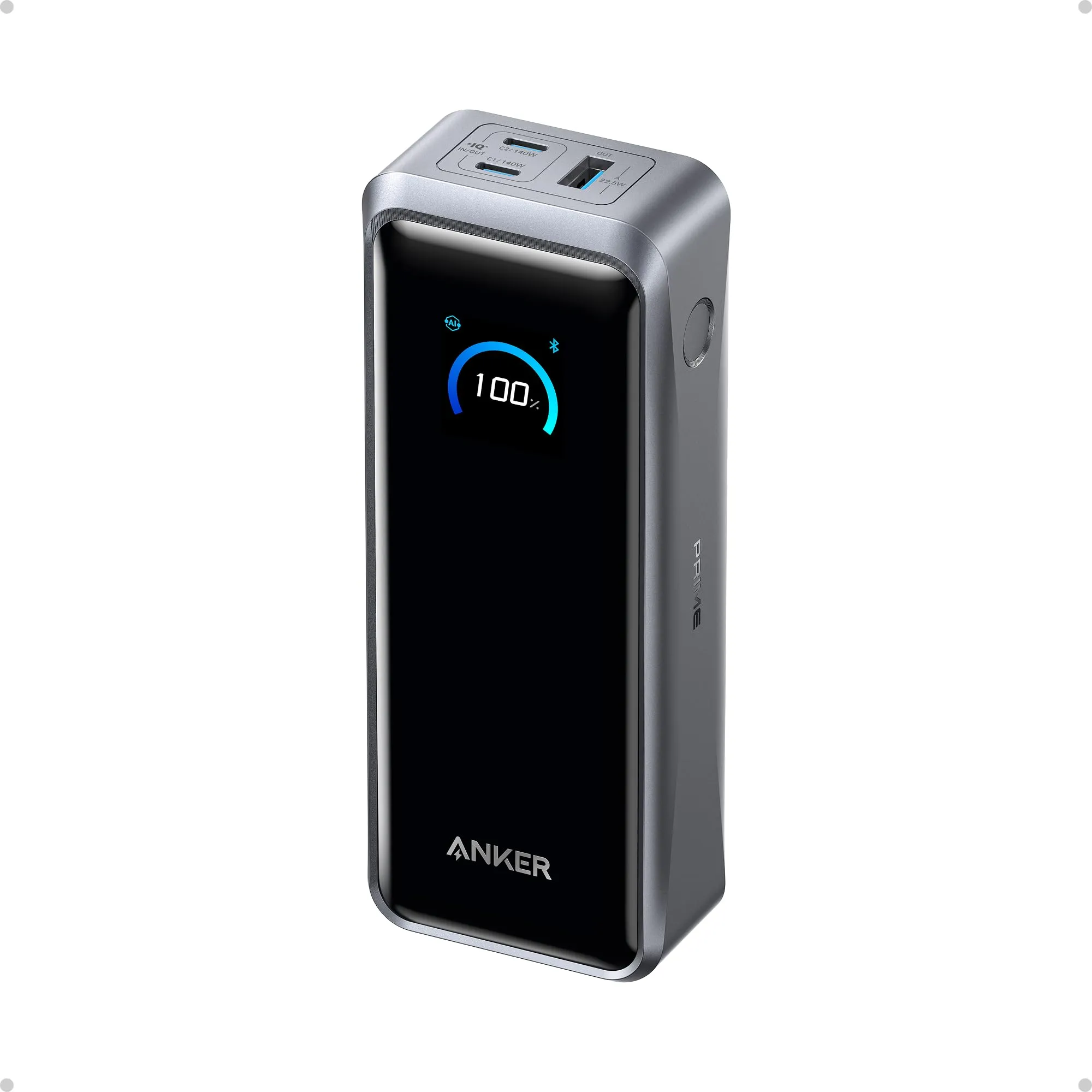
Anker Prime 26K 300 W
- Capacity
- 26,250 mAh
- Energy
- 99.75 Wh
- Max output
- 140 W
- Weight
- 600 g
- Built-in cable
- No
Check price on Amazon.co.uk
The Prime is engineered to the airline limit: 26,250 mAh and a printed 99.75 Wh, which Anker calls hand-luggage approved and which sits a quarter of a watt-hour under the 100 Wh line at which approval would be needed. Either USB-C port delivers up to 140 W at PD 3.1’s 28 V level — the full speed of a 16-inch MacBook Pro — the USB-A gives 22.5 W, and the total across three devices is 300 W. It recharges at 140 W per port or 250 W across two, and a display plus an app show what each port is doing.
Anker is candid about delivered capacity: about 15,200 mAh, with energy loss “typically 30–45 %”. The cost is the bank itself: 159.9 × 38 × 62.7 mm and 600 g, a brick that lives in a laptop bag. The warranty is Anker’s hassle-free, 24 months per the listing; Anker’s page does not state it.
For a long-haul flight with a laptop and a phone, or a day running two laptops off one bank, nothing smaller does it. For a phone, it is absurd.
Strengths
- 99.75 Wh stated — just under the 100 Wh line
- 140 W per USB-C port; 250 W recharge across two ports
- Display and app show what is going where
Limitations
- 600 g and 16 cm long
- About 15,200 mAh actually delivered — Anker's own figure
- Warranty length not stated by Anker
Good for
- a 16-inch MacBook Pro or two laptops
- a long-haul flight
- a working day away from sockets
Look elsewhere if
- a phone-only bag
- anyone who weighs their bag
How to choose
- Devices first. Phone only: 5,000–10,000 mAh at 20–45 W. Phone plus tablet or a MacBook Air: 10,000–20,000 mAh at 45–65 W. Laptop: 20,000 mAh or more at 100–140 W.
- Weight you will carry. 122 g (MagGo) to 600 g (Prime). The banks that travel every day are the ones under 250 g.
- Printed Wh if you fly: Samsung, UGREEN and Anker Prime print theirs; the others do not.
- Ports and cables. Built-in cable (Anker 10K), MagSafe (MagGo), USB-A for old leads (INIU, Anker 10K, UGREEN, Prime).
- Recharge speed. 65 W (UGREEN, 1.6 h) and 140–250 W (Prime) refill over lunch; 20–30 W banks take an evening.
Then the flight rules: two per person, cabin only, individually protected, and on Ryanair on your person or under the seat.
Who should not buy a power bank
If your commute is under an hour and your phone lasts a day, a 20 W wall charger at the desk does more for less. If the problem is a laptop that dies mid-afternoon, a second charger left at the office beats a 600 g bank. And if you already own a bank made before 2025, check Anker’s UK recall page and the OPSS recall list before packing it — the A1647, A1681 and A1689 were recalled in July 2025 for overheating cells.
Which one, by situation
- iPhone, pocket, one top-up: Anker Nano 5K MagGo.
- Samsung, commute, three-year warranty: INIU P41.
- Never the right cable: Anker Nano 10K with built-in cable.
- Galaxy household, Wh on the case: Samsung 20,000 mAh 45 W.
- Laptop on a train, honest numbers: UGREEN Nexode 100 W.
- 16-inch MacBook Pro, long-haul: Anker Prime 26K.
Sources
Facts checked 24 September 2026
- UK Civil Aviation Authority — changes to rules on the carriage of lithium batteries and power banks (effective 27 March 2026) — Standard or regulation, checked 24 September 2026
- UK Civil Aviation Authority — Pack right. Safe flight. — Standard or regulation, checked 23 September 2026
- Ryanair Help Centre — What items are permitted on board (updated 2026-08-21) — Other source, checked 24 September 2026
- easyJet — dangerous goods page (and restricted-items help page) — Other source, checked 24 September 2026
- Which? — How to buy the best portable power bank charger (June 2026) — Press material, checked 24 September 2026
- OPSS (gov.uk) — Product recall: Anker power banks A1681, A1689 and A1647 (2507-0045, 23 July 2025) — Standard or regulation, checked 24 September 2026
- Anker UK — Nano Power Bank (5K, MagGo, Slim) A1665 product page (spec sheet on service.anker.com) — Manufacturer documentation, checked 24 September 2026
- Amazon.co.uk listing (Anker) — Retailer listing, checked 24 September 2026
- INIU — P41 45W 10000mAh power bank product page — Manufacturer documentation, checked 24 September 2026
- Amazon.co.uk listing (INIU) — Retailer listing, checked 24 September 2026
- Anker UK — Nano Power Bank (10K, 30W, Built-In USB-C Cable) A1259 product page — Manufacturer documentation, checked 24 September 2026
- Amazon.co.uk listing (Anker) — Retailer listing, checked 24 September 2026
- Samsung UK — 20,000 mAh Battery Pack 45W EB-P4520XUEGEU (Wh from the US spec page) — Manufacturer documentation, checked 24 September 2026
- Amazon.co.uk listing (Samsung) — Retailer listing, checked 24 September 2026
- UGREEN — Nexode Power Bank 20000mAh 100W (item 25188) specification table (US store; UK store's spec block did not render) — Manufacturer documentation, checked 24 September 2026
- Amazon.co.uk listing (UGREEN) — Retailer listing, checked 24 September 2026
- Anker UK — Prime Power Bank (26K, 300W) A110A product page and UK service spec (26,250 mAh, 99.75 Wh) — Manufacturer documentation, checked 24 September 2026
- Amazon.co.uk listing (Anker) — Retailer listing, checked 24 September 2026
Can I take a power bank on a Ryanair or easyJet flight?
Yes, in the cabin, and the rules got stricter in 2026. The UK Civil Aviation Authority's rule change effective 27 March 2026 limits you to two power banks per person, in carry-on baggage only, not recharged on board, not used to charge devices on board, and individually protected when not in use; up to 100 Wh needs no approval, 100–160 Wh needs the airline's approval, over 160 Wh is prohibited. Ryanair adds that banks must be on your person or in the under-seat bag, not in the overhead locker, and allows using them to charge a phone except during taxi, take-off and landing; easyJet bans both recharging and using them in flight. Every bank here is under 100 Wh.
Why does a 10,000 mAh bank only charge my phone twice?
Because 10,000 mAh is the capacity of the cells at their own 3.6–3.7 V, and getting it into a phone at 5 V or more through a cable loses 30 to 45 per cent — Anker's own FAQ figure. UGREEN prints both numbers on its 100 W bank: 20,000 mAh of cells, 11,300 mAh delivered. Anker says its 5,000 mAh MagGo delivers an estimated 2,750 to 3,500 mAh. A 4,500 mAh phone therefore gets roughly one and a half charges from a 10,000 mAh bank, not two.
How do I know the watt-hours if the maker does not print them?
The CAA's formula is (V × mAh) ÷ 1000 = Wh, and 3.7 V is the usual cell voltage: 10,000 mAh is about 37 Wh, 20,000 about 74 Wh, 26,250 about 97 Wh. Samsung, UGREEN and Anker's Prime print their Wh (74, 72 and 99.75); Anker's Nano banks and INIU do not, so the figures in our table for those are computed and marked. Which? warns that a bank close to the limit without a printed rating can be confiscated, and HuffPost UK reported Jet2 refusing banks with no Wh printed — if you fly often, buy one with the number on the case.
How many watts do I need for a laptop?
A USB-C laptop charges from a bank the way it does from a charger: it negotiates what the port can supply. A MacBook Air runs on 30 W and charges properly at 45–65 W; a 14-inch MacBook Pro or 65 W Windows laptop wants 65–100 W; a 16-inch MacBook Pro's own adapter is 140 W. Here that means the UGREEN (100 W) or Anker Prime (140 W) for laptops, the INIU and Samsung (45 W) for a MacBook Air at a pinch, and the two Nano banks (20–30 W) for phones and tablets only.